At dawn in Zarzis and Sfax, the docks tell a different story than the sea. Crates of sharks lie stacked beside nets still wet with salt. What was once bycatch is now a commodity. What was once released is now priced per kilo.
Along Tunisia’s coast, fishing has changed , not only in method, but in motive. Gillnets no longer discriminate. Trawlers scrape the seabed despite the law. Juveniles are landed before they have a chance to reproduce. Pregnant females are hauled ashore before they can give birth.
The sea is still being fished. But something deeper is being emptied.
Nets of No Return: A Trap No Shark Can Outswim
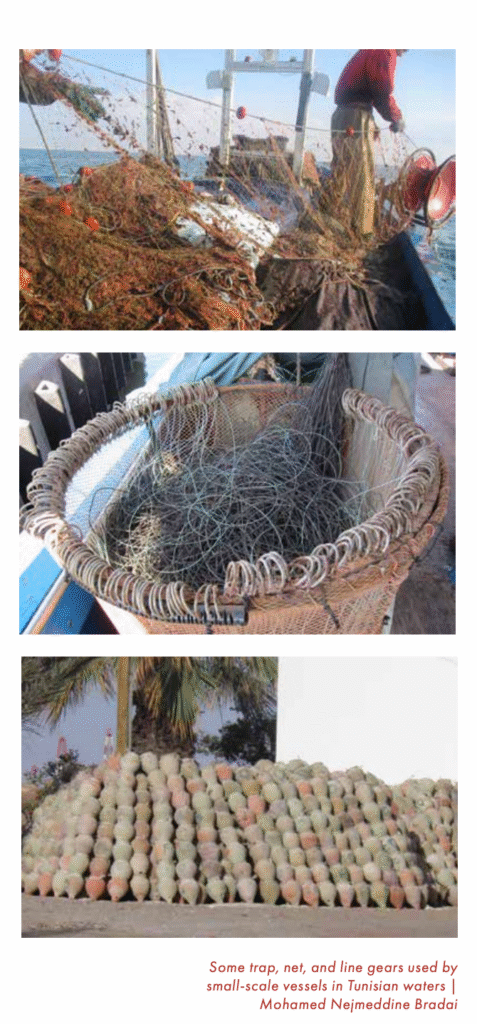
Credit: Mohamed Nejmeddine Bradai
A fishing method that’s quietly emerging and shaping the fate of Tunisia’s sharks is known locally as “Garassiya” or “Kellabiya,” this type of gillnet changes its target depending on the season. From late April to June, during spring and early summer, fishermen deploy the “Kellabiya” to catch sharks, named after the Grey Shark, or “Kelb El Bahr.”
These nets are powerful tools, capable of trapping large, mature sharks, including pregnant females. One example is the net locally known as “Gattatiya.” The researcher describes it as a medium-mesh net, typically between six and eight centimeters, primarily used to target smooth-hound sharks, or “Gttat.”
In reality, however, its design allows many other shark species to become entangled. Bycatch, he notes, is no longer accidental,it is systemic.
In Zarzis, on Tunisia’s southeastern coast, where the sea defines both landscape and livelihood. We found Salim Khouildi, a fisherman, in a region where sharks and rays have long shaped both the ecosystem and the economy. Here, shark fishing is known simply as “Houch” passed down, like the practice itself.
Khouildi learned the craft from his father in 1990. What began as inherited knowledge has since become a livelihood negotiated with a changing sea and an unforgiving market. We came to him not only to understand the fate of sharks, but to learn the language of nets, seasons, and species from the perspective of a man who has lived this fishery from the inside.
When he speaks of fishing gear, his voice tightens. The greatest threat to sharks today, he says, lies in a single net: the Gattatiya. Khouildi says, marine resources have declined by nearly 80% compared to previous years. Each year, “el houch”, local sharks and ray species such as Sandbar Shark, Blackchin Guitarfish known scientifically as Glaucostegus Cemiculus and Stingray Dasyatis pastinaca locally known as Hmam continue to disappear at an alarming pace. Just three years ago, catches were measured in tons; today, many fishers return with no more than five or six individuals per day.
Khouildi identifies “gatatiya” fishing, particularly the type of which has a mesh size, typically ranging between 45 and 50 centimeter , is one of the most destructive practices. Its impact is especially severe between 10 July and 15 August, a critical reproductive period for sharks and rays.
” A single gatatiya net of this type can capture 170 to 200 crates of juvenile sharks, so underdeveloped they are extremely fragile to the touch and still bear an open umbilical wound.” He explains.
” A single gatatiya net of this type can capture 170 to 200 crates of juvenile sharks, so underdeveloped they are extremely fragile to the touch and still bear an open umbilical wound.”
Scientists explain that a shark caught with this wound is barely 24 days old, highlighting just how premature and vulnerable these young sharks are when caught.
This practice is widely used in the Gulf of Gabès and around Djerba, areas already under intense ecological pressure.
For Khouildi, Gatatiya fishing during the breeding season is stripping the sea of its future. He urges authorities to ban this gear during reproductive periods, arguing that protecting sharks and rays must begin before they are even born.
A mesh that does not choose. It entangles everything in its path, adults and juveniles alike. In another time, the smallest sharks would have been returned to the water. Now, rising prices leave little room for release.
In the same context, Saïdi warns this selective catch puts immense pressure on the most vital members of the population. Removing pregnant females, he explains, accelerates the sharp decline in shark numbers, especially in the Gulf of Gabès.
From a conservation perspective, the researcher is clear: “pregnant sharks should never be brought to shore”. Instead, they must be released to give birth and sustain the population. With sharks’ slow reproductive rates and low birth numbers, losing breeding females threatens the entire future of these species.
The warning signs, he explains, are already visible at sea. In the shallow waters of the Gulf of Gabès, fishing boats return day after day with lighter holds, revealing the cumulative cost of fishing practices that have changed little over time.
In fact, Saïdi stresses that an urgent revision of fishing gear and management is now unavoidable. In ecologically fragile areas like the Gulf of Gabès, even small disruptions can trigger cascading effects across the marine ecosystem.
More than 50 percent of sharks caught worldwide,including in Tunisia, are taken as bycatch rather than through targeted fishing. This unintended pressure, he warns, is quietly eroding populations already weakened by overfishing.
“More than 50 percent of sharks caught worldwide,including in Tunisia, are taken as bycatch rather than through targeted fishing.”
Researcher Saïdi, draws attention to illegal practices that persist along the coast. Some fishers, he says, continue to deploy trammel nets in shallow waters where fishing is restricted. These coastal zones serve as nursery grounds, and their degradation disproportionately affects juvenile sharks.
Beyond cartilaginous species, he emphasizes that poorly regulated fishing in the Gulf of Gabès has damaged entire fish stocks. Fishers themselves report the same pattern: declining catches, shrinking fish sizes, and longer trips at sea.
As resources near shore collapse, he observes that vessels increasingly move toward new fishing grounds. The pressure shifts outward, but the cycle remains unchanged, placing previously less-exploited areas at risk of the same fate.
Several elasmobranch species are now standing on the edge of extinction in Tunisian waters. He warns that unregulated fishing,much of it incidental,has placed immense pressure on sharks and rays, particularly in the Gulf of Gabès.
Among the most vulnerable are guitarfish( listed in CITES Appendix II) , locally known as “El Mehraath,” and the sandbar shark (listed in CITES Appendix II), often called the grey shark. These species are rarely targeted. Instead, they are repeatedly caught as bycatch,pressure their slow reproductive biology simply cannot absorb.
According to him, the window for action is closing fast. Reducing bycatch is now critical. So is raising awareness among fishers, especially about releasing pregnant females and juveniles before irreversible damage is done.
This threat is no longer hypothetical. Some species, Saïdi notes, have already vanished.
The angel shark (listed in CITES Appendix II) is one of the clearest examples. Belonging to the genus Squatina (Squatina squatina, S. oculata, and S. aculeata), these sharks were once a familiar sight along Tunisia’s coast. Scientific surveys from the 1970s and 1980s recorded them in significant numbers, particularly in the Gulf of Gabès.
By the early 2000s, the picture had changed dramatically. Between 2002 and 2005, fewer than 20 individuals were recorded. Soon after, angel sharks disappeared entirely from Tunisian waters.
Saïdi says hammerhead sharks( listed under CITES Appendix II) followed the same path. In the 1970s and 1980s, fishers reported encountering Sphyrna species almost daily. Today, they are considered functionally extinct in Tunisia. Since 2005, only one or two isolated sightings have been reported.
These losses are not isolated events. They are warnings. Without enforceable regulations, protection of breeding individuals, and safeguards for critical habitats, other shark and ray species may soon follow the same trajectory,pushing Tunisia’s marine ecosystems, and its fisheries, closer to collapse.
Bottom Trawling: The New Pirates of The Mediterranean Sea
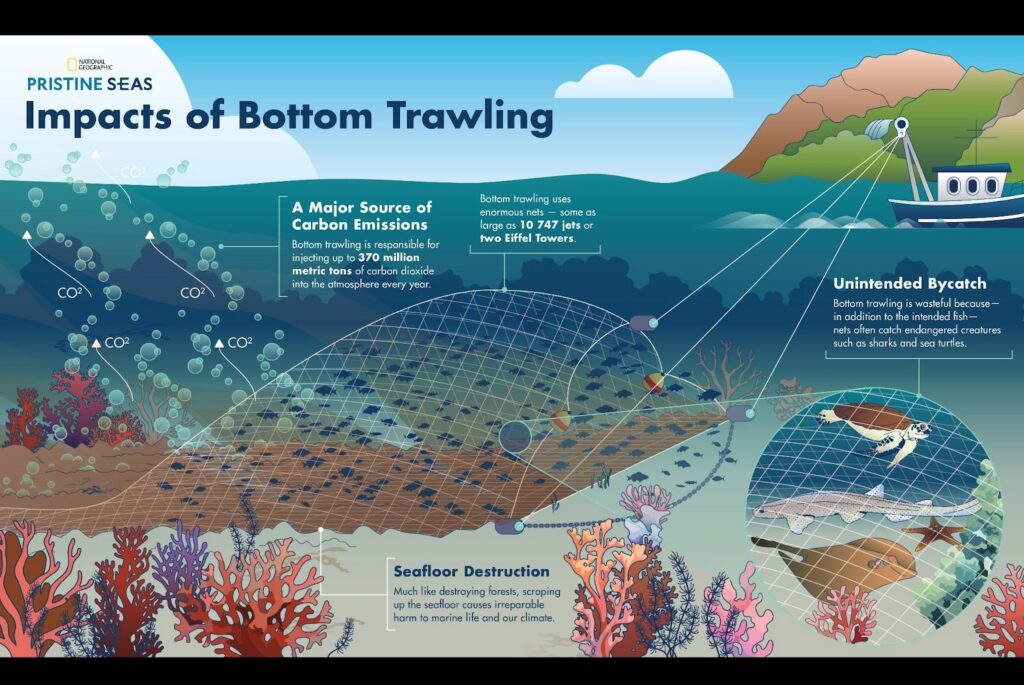
Infographic by National Geography,
Along Tunisia’s coast, bottom trawling has become one of the most destructive practices facing the marine environment. Despite being illegal under Tunisian law (law n°94-13), more than 2,288 anonymous and unregistered trawlers now operate along the shoreline, especially in the Gulf of Gabès and around Sfax, Kerkennah, and Gabès.
Fishermen say with a trawler, they earn up to ten times more than with traditional gear, making bottom trawling attractive despite its illegality and known harm.
The gear itself, known locally as Karkara or Kiss, drags heavy nets and chains across the seabed. This method is highly unselective. Only 18–25 % of catches have commercial value, while more than 25 % are tiny specimens under 1 cm that die and are discarded.
In fact, researcher Saïdi warns that these nets don’t just take fish. They destroy habitats. By crushing the seabed, they uproot seagrass meadows, coral, and other foundational ecosystems. Sediment is churned, increasing water turbidity and releasing buried contaminants.
The scale of the problem has ballooned over decades. A 1992 study recorded 404 trawlers in Tunisia. By 2021, that number had jumped to more than 2,388 , roughly 90 % of them around Sfax. Some estimates now place the fleet above 3,000 vessels, many owned by people outside the fishing community.
“A 1992 study recorded 404 trawlers in Tunisia. By 2021, that number had jumped to more than 2,388 , roughly 90 % of them around Sfax.”
From Zarzis, we moved north to the Sfax region, on Tunisia’s central-eastern Mediterranean coast. We traveled to Ellouza, where we met Mohamed Dahech, a local fisherman whose connection to the sea began in childhood, passed down from his father.
Over the years, Dahech has tried nearly every fishing method, from traditional techniques to more modern practices. But when the conversation turned to bottom trawling, his tone shifted.
According to Dahech, trawling has deeply harmed local fishers. He says many boats operating in the area belong to outsiders who use trawling gear, accelerating the depletion of marine resources. The impact, he adds, has been severe. Faced with shrinking catches and unfair competition, many local fishers have been forced to sell their boats and abandon the profession altogether.
With a calm but resolute tone, he paints a stark picture of the future if bottom trawling continues unchecked. He believes that banning this destructive practice could free fishermen from relying solely on sharks, allowing them to catch a wider variety of species.
But change won’t happen overnight. For Dahech, the key lies in education through workshops that inform fishermen about the hidden damage caused by bottom trawling. Without this awareness, illegal fishing will push vulnerable species closer to extinction.
The consequences, he warns, will ripple through generations, turning the once-thriving sea into little more than a place to swim during summer, stripping coastal families of their traditional source of livelihood.
Regulations theoretically restrict trawling to depths greater than 50 meters and outside the biological rest period from July to September. Yet most trawlers are unregistered and evade monitoring systems like satellite tracking. As a result, enforcement is weak and the practice continues openly along shallow seas that should be protected.
Yet, local fishers and conservation groups now call for stronger enforcement, better traceability of vessels, and greater awareness in the sector to protect biodiversity and secure sustainable fishing futures.
When Sharks Become Currency at Sea
Fisherman Mohamed Dahech told us that he has chosen to focus primarily on shark fishing for practical and economic reasons. According to him, this activity is considered relatively easy and cost-efficient, as it does not require frequent replacement of fishing gear. The gillnets used to catch sharks can remain operational for periods ranging from four to ten years, reducing operational costs for fishers.
Dahech added that shark meat generates substantial income on local Tunisian markets, making the activity economically profitable. Among the species he most frequently lands are guitarfish , tuna, and various species of rays.
Fisherman Salim Khouildi also echoed Dahech’s views. He emphasized that shark and ray fishing remains one of the most lucrative activities for local fishers. According to Khouildi, a single day of shark fishing can yield up to 12,000 TND, while four days spent fishing for cuttlefish bring in no more than 2,000 TND.
From a scientific perspective, such testimonies highlight how economic incentives and low fishing costs continue to drive pressure on vulnerable elasmobranch species, many of which already suffer from slow growth and low reproductive rates.
Among the gillnets used to catch sharks, Garasiya is a widely used type of net that is non-selective. It captures a broad range of shark species, including guitarfish( listed in CITES Appendix II) , eagle rays known locally as “Bagra” , grey sharks (listed in CITES Appendix II) known as “Kelb Bhar”.. Due to its design and mesh size, the Garrasia net also traps most cartilaginous fish, making it particularly impactful on elasmobranch populations.
Is Shark Fishing No Longer Profitable for Tunisian Fishers?
The most active shark fishing areas in Tunisia have traditionally been Sfax, the Chebba coastline, and the Kerkennah Islands. However, due to overfishing and unregulated fishing practices, shark stocks in coastal waters have sharply declined. As a result, fishers are increasingly moving into deeper waters in search of sharks, a shift that reflects the growing scarcity of these species in their traditional fishing grounds.
Dahech knows the sea better than most. For years, like many fishermen along Tunisia’s coast, he made his living catching sharks. The local market still hungers for their meat, and the trade is too profitable to ignore. But over time, Dahech saw something changing beneath the waves.
He began to notice the slow disappearance of familiar faces,the smoothhound sharks, known as “Gtate,” the Angelsharks or “Waggas,” the Guitarfish called “Mehrath,” and others like the rays and the common torpedo, “Naas.” These creatures, once plentiful, were now growing rare. “Fishing pressure is relentless,” Dahech says, “and there’s little regulation to protect them.” The decline felt personal.
Then came a turning point. Dahech attended training workshops, where he learned not just about fish, but about the fragile balance of the whole marine ecosystem. His curiosity turned into commitment. Now, during the shark breeding season, he watches his nets closely. If a pregnant female is caught by accident, he gently releases her back into the sea, giving life a chance to continue.
More than that, Dahech became a quiet ambassador. He urges other fishermen to adopt these practices, hoping that respect for the sea will spread. For him, the sea is not just a livelihood, it’s a legacy worth protecting.
Reflecting on past decades, Dahesh notes that twenty years ago the sea was far more generous. At the time, fishers needed to venture no more than 400 meters from the shoreline to return home with nets full of diverse fish species. Today, the reality is starkly different. Fishing has become increasingly difficult, and throughout the year, fishers struggle to secure a stable daily income. Despite traveling farther offshore, fish stocks continue to decline, forcing many fishers to spend up to three consecutive days at sea without any catch.
The Consequences of Declining Shark Populations
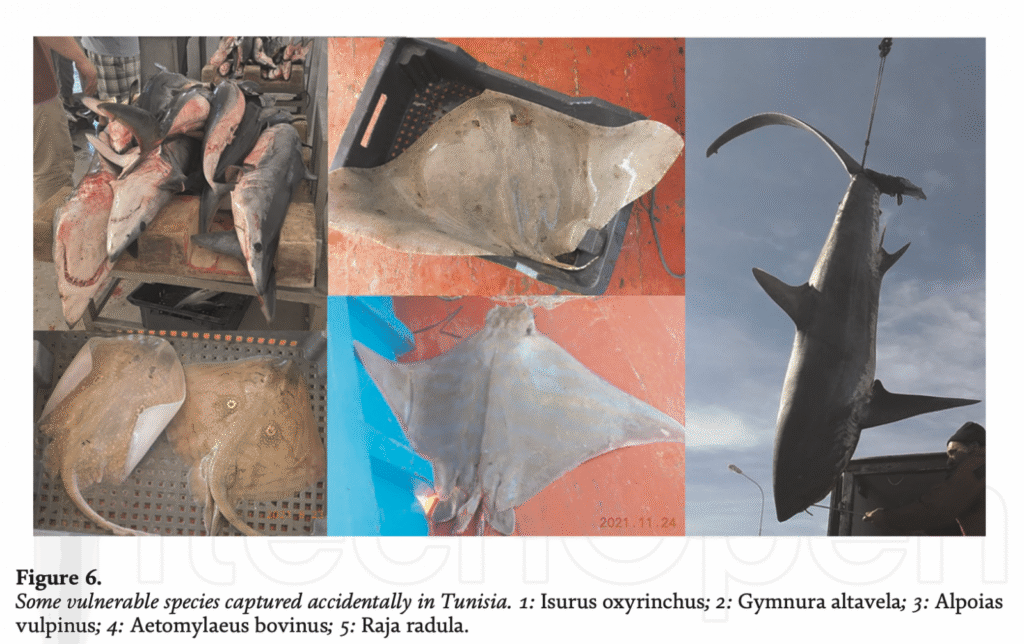
Researcher Saïdi stressed on the direct socio-economic consequences of shark populations decline on Tunisian fishers. Due to the sharp reduction in fish stocks, trips that once required two nights at sea now extend to three or more, as fishers struggle to secure sufficient catch in their nets. This, he explains, is a clear indicator of ecosystem imbalance.
Beyond its immediate economic impact, the disappearance of sharks would have severe ecological repercussions. As apex predators, sharks play a crucial role in regulating marine food webs. If sharks were to vanish, the species they normally prey upon would multiply rapidly, leading to an uncontrolled increase in mid-level predators. This, in turn, would place intense pressure on lower trophic levels, disrupting the entire food chain.
He warns that the absence of sharks would also create ecological vacancies, facilitating the expansion of invasive species, which often thrive in disturbed ecosystems. Such species can further degrade marine habitats and compete with native fish stocks, ultimately causing additional losses for local fisheries.
Over time, this cascading disruption would affect the entire marine system. As ecological balance deteriorates, fish stocks would continue to collapse, leaving fishers with fewer resources to harvest and threatening the long-term sustainability of coastal livelihoods.
Citing several scientific studies, Saïdi stresses that the extinction of sharks could have consequences that extend far beyond the marine environment. By destabilizing sea ecosystems that regulate climate, oxygen production, and food security, the disappearance of sharks could ultimately pose a serious threat to human survival itself, underscoring the critical importance of protecting these key species.
Consuming Shark Meat: A Risky Meal Confirmed by Science
From a public health perspective, Saïdi notes that shark meat is not traditionally part of the Tunisian diet, having been consumed only occasionally in southern regions such as Zarzis and Djerba. Its growing presence on markets over the past two decades, he explains, is largely a result of declining fish stocks.
But this shift comes with risks: as apex predators, sharks accumulate high levels of mercury and other heavy metals, making frequent consumption potentially harmful, particularly for children and pregnant women. For Saïdi, this health concern further underscores the urgency of limiting the exploitation and consumption of already threatened shark species.
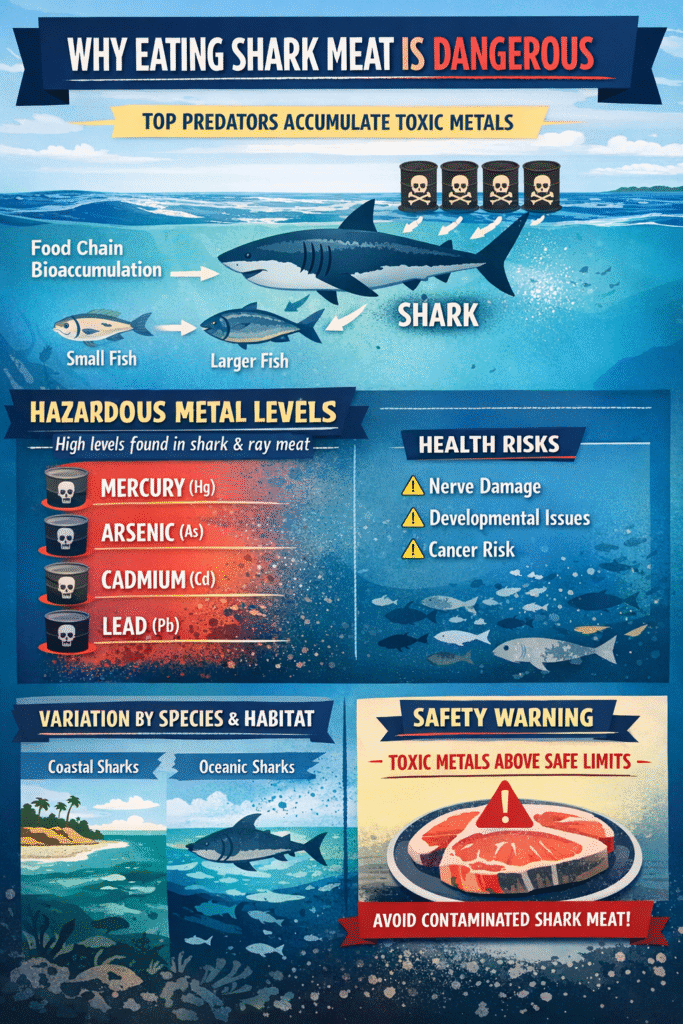
In addition , a recent PubMed study found that shark and ray meat sold for consumption often contains toxic metals like mercury, arsenic, cadmium, and lead at levels exceeding safety limits. These concentrations vary by species and habitat, with some coastal species showing higher contamination.
Because sharks and rays are top predators, they accumulate these harmful substances through the food chain, posing potential health risks,especially neurological and developmental, to consumers. The study highlights the need for clear species labeling to help people avoid the most hazardous products.
The numbers speak of pressure. The fishers speak of scarcity. Scientists speak of collapse. Between them lies a system where economic survival and ecological survival are increasingly at odds.
Sharks have become currency , sold, weighed, exported, consumed, even as their disappearance reshapes the marine food web beneath Tunisia’s waters. And yet, much of what is happening is neither hidden nor accidental. It unfolds in plain sight, at ports, in markets, and within legal grey zones.
If nets are not the only problem, then the next question is unavoidable: when laws exist but declines continue, where does responsibility truly lie , and who has the power to change the course before the silence becomes permanent?
Copyright © 2026 Blue Tunisia. Tous droits réservés