For decades, Hollywood taught us to fear the shark. Films like Jaws and Deep Blue Sea turned it into a villain. In the real world, the roles are reversed. In Tunisian waters, sharks are no longer the hunters.
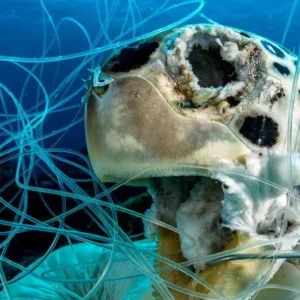
They are the hunted ones . Caught unintentionally in industrial fishing nets, they disappear without record or protection. These ancient predators are paying the price for a system that values volume over balance. As trawlers sweep the seafloor clean, fishermen are driven to go further into the sea in search of catch, whilst sharks are pushed toward extinction, victims of a story humans never learned to tell correctly.
A Living Mosaic of Sharks Beneath Tunisian Waters
Speaking facts , sharks and other elasmobranchs constitute a biologically significant component of Tunisia’s marine biodiversity, reflecting the country’s strategic position within the central Mediterranean. According to the most recent comprehensive scientific synthesis, 63 elasmobranch species have been reliably recorded in Tunisian waters, including 37 shark species (Selachii) and 26 batoid species (Batoidea) (Enajjar, Saidi & Bradai, 2022).
“63 elasmobranch species have been reliably recorded in Tunisian waters, including 37 shark species (Selachii) and 26 batoid species (Batoidea)..”
Dr. Bechir Saïdi, a PhD marine biologist from the University of Sfax, a specialist in shark taxonomy, biology, and fisheries, and a member of the IUCN Shark Specialist Group. For more than two decades, he has followed the silent movements of sharks through Tunisian waters, documenting lives most people never see.
When we met him, he spoke with calm authority, measuring each word like a scientist and a witness. Tunisia, he tells us, is not a blank space on the shark map. According to the latest data, its waters host nearly 39 shark species. Some are only passing shadows in migration. Others never truly leave.
The Longnose Spurdog. The Smallspotted Catshark. The Sandbar Shark. Year after year, season after season, they trace the same coastal paths. For Saïdi, this constancy is more than a statistic. It is proof that Tunisia is not merely a corridor in the Mediterranean. It is a home..
While some sharks make Tunisia their permanent home, others are rare visitors, drifting through the waters only once or twice a year. Researcher Saïdi points to these occasional guests as large pelagic species ,the formidable Great White (Carcharodon carcharias), the sleek Thresher Shark (Alopias vulpinus), and the gentle giant Basking Shark (Cetorhinus maximus).
Their sporadic appearances follow the rhythm of seasonal migrations, weaving Tunisia into the vast tapestry of Mediterranean marine movements.
Recent data from fisheries-dependent monitoring shed new light on the presence of large pelagic and deep-water sharks along Tunisia’s coast. Between 2023 and 2024, systematic observations at key landing ports,including Sfax, Teboulba, and Zarzis which recorded catches of several vulnerable and endangered species. Among them were the shortfin mako (Isurus oxyrinchus) and the bluntnose sixgill shark (Hexanchus griseus) .
While these landings don’t provide exact population counts, they offer strong evidence that these rare species continue to use Tunisian waters, underscoring the ecological importance of the region.
The Gulf of Gabès, a Living Archive of the Sea
Amid Tunisia’s marine landscape, the Gulf of Gabès stands out as a vital refuge for shark and ray diversity. Its broad continental shelf and shallow waters create an ideal environment that supports a rich variety of elasmobranch species.
According to Enajjar et al. (2022), the Gulf has long been recognized as a crucial zone for feeding, reproduction, and the growth of juvenile sharks and rays. Yet, these same ecological strengths make the area particularly vulnerable to intense fishing activity, where both artisanal and industrial fleets increasingly cross paths with these sensitive species.
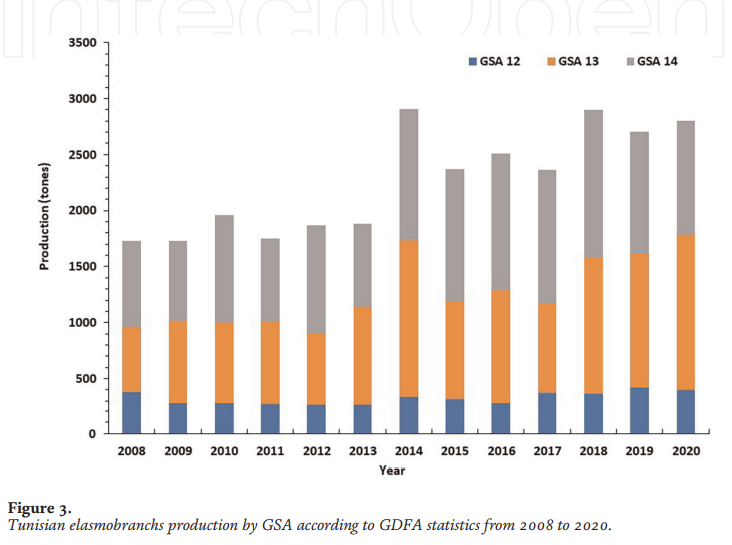
In fact, the Gulf of Gabès has long been recognized as the most important region for sharks and rays in Tunisia, historically accounting for more than 60 % of national elasmobranch landings (Enajjar et al., 2022). Nevertheless, official fisheries statistics indicate a notable spatial shift in landing patterns.
Data published by the General Directorate for Fisheries and Aquaculture (GDFA) for the period 2008–2020 reveal a steady increase in elasmobranch landings from the Eastern Tunisian region . By 2020, this area contributed over 49 % of total national elasmobranch production, reflecting a substantial redistribution of fishing pressure along the Tunisian coastline.
Biologically on the Brink : Strong in size, fragile in fate
Researcher Saïdi paints a stark picture of sharks in Tunisian waters. Nearly all species are now threatened with extinction. Their biology makes them highly vulnerable to fishing pressure.
Take the Sharpnose Sevengill, locally called “Gtat” (Heptranchias perlo). It produces fewer than ten pups per year and breeds only once annually. This slow cycle limits population recovery.
The Sandbar Shark, or “Kelb Bhar” (Carcharhinus plumbeus, listed under CITES Appendix II), reproduces even less often. Females give birth once every two years to six or seven pups. These low reproductive rates make them especially sensitive to fishing.
He warns that even small amounts of unregulated or accidental catch can cause sharp declines. This is not just theory.
Tunisian fishers have seen the drop themselves. In less than 15 years, many shark populations along the coast have collapsed. This highlights the urgent need for better monitoring and stricter fisheries management.
Tunisia is far from a blank spot on the Mediterranean shark map. It serves as a refuge, a vital migratory corridor, and for many species, a permanent sanctuary. The Gulf of Gabès, with its expansive continental shelf and rich nursery grounds, stands out as one of the region’s ecological jewels.
But nature’s clock is unforgiving. Sharks grow slowly, mature late, and produce few offspring. When their numbers decline, recovery is measured not in years, but in decades.
These ancient predators have weathered mass extinctions and shifting seas over millions of years. Yet today, in the Mediterranean, a new and relentless threat looms, one that risks pushing them to the edge of silence.
As biological resilience reaches its limit, what human forces are driving this crisis?
Copyright © 2026 Blue Tunisia. Tous droits réservés