On 5 June 2026, protesters in Tunis and Chott Sidi Abdel Salam renewed demands for action against pollution from the Tunisian Chemical Group’s (GCT) industrial units in Gabès. Their mobilisation followed a February 2026 court decision rejecting an urgent request to suspend or restrict GCT operations, reportedly on the grounds of insufficient proof of harm.
But this lack of proof sits at the heart of an accountability problem: the monitoring systems needed to produce evidence of harm are non-existent, outdated, or limited. The absence of proof can then be used to delay enforcement, while funding continues to flow towards an industry whose promised clean-up remains unfinished.
From Protests to Courtroom
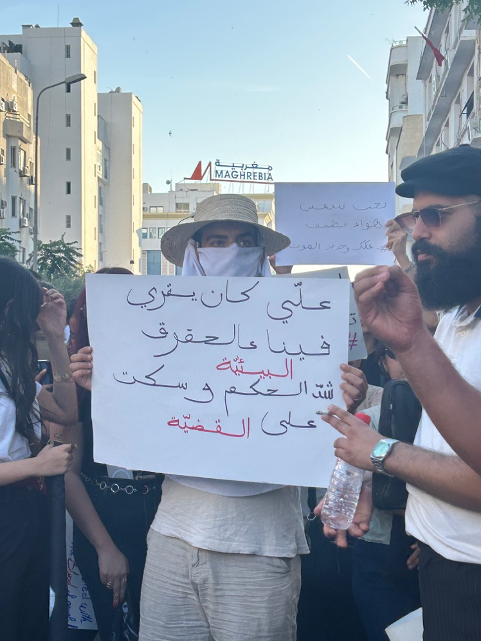
In light of World Environment Day, celebrated yearly on the 5th of June, protests in Tunis and Chott Sidi Abdel Salam took place in condemnation of the continuing environmental crisis in Gabès. The next day, protesters marched from the Court of First Instance of Gabès to the governorate headquarters.
By October 2025, years of slow but fatal damage had accumulated: rising rates of respiratory illness and cancer, harm to marine life and the fishing industry, and a long record of unfulfilled government promises. Many residents saw these changes as the consequence of years of industrial emissions.
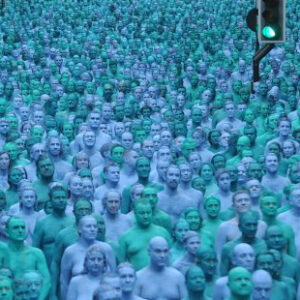
But it was the rise in asphyxiation cases among Chott Essalem school children from September to October 2025 that sparked the eruption of these accumulated frustrations. This materialised in a reported 100,000+ citizens taking to the streets on October 21, 2025.
“The rise in asphyxiation cases among Chott Essalem school children from September to October 2025 that sparked the eruption of these accumulated frustrations.”
Protesters’ demands included calls such as “Gabès wants to live” and “dismantle the polluting units.” The mobilisation also extended beyond street demonstrations. On 21 October 2025, a regional general strike was held in Gabès, with shops, markets and schools closing, according to reports on the mobilisation.
Against this backdrop, the Gabès Regional Branch of the Tunisian Order of Lawyers, working with the Stop Pollution collective, brought an urgent case against the Tunisian Chemical Group (GCT), seeking the suspension of industrial units identified in the proceedings as polluting. The case sought immediate measures through summary proceedings.
After several postponements, the Gabès Court of First Instance issued its ruling on 26 February 2026 and rejected the request to suspend the activities. According to statements by Mounir Laâdouni, president of the regional branch of lawyers, the court considered that the alleged harm had not been sufficiently established and that technical and scientific expertise was required. The lawyers’ branch subsequently announced that it would appeal the decision.
The ruling came after years of public mobilisation over industrial pollution in Gabès, including demonstrations and complaints concerning emissions from the industrial complex. The extent and nature of environmental impacts have also been addressed in technical assessments.
Among the publicly available documents is the 2025 Environmental and Social Compliance Audit of GCT’s sites in Gabès, Skhira and M’dhilla. The audit was conducted as part of the preparation of a GCT support project involving the African Development Bank and assessed the sites against Tunisian legislation, the AfDB’s environmental and social safeguards and other applicable standards.
The Gabès audit identified instances of non-compliance in several areas, including environmental and social management. It also examined the monitoring and management of emissions and other environmental impacts at the site. These findings provide documented information about conditions identified during the audit, but they do not establish what evidence was considered by the court in the February 2026 proceedings or whether the audit was relied upon in reaching the ruling.
The case therefore provides a point of entry into a broader examination of the evidence available on pollution associated with GCT’s Gabès operations. This includes the findings of the 2025 environmental and social audit, as well as the measures subsequently proposed or financed to improve the environmental performance of the group’s industrial facilities.
The African Development Bank’s support project, approved in 2025, is intended to contribute to the environmental upgrading and rehabilitation of GCT production units in Gabès, Skhira and M’dhilla, including measures aimed at improving environmental and operational performance.
These measures form part of a longer series of environmental improvement initiatives involving GCT. Examining the projects, their implementation timelines, monitoring mechanisms and publicly available results can help establish what measures have been undertaken, what remains in progress, and what evidence is available regarding their environmental impact.
GCT’s position within Tunisia’s phosphate and fertilizer industry also forms part of this context. The group’s industrial activities are connected to employment, exports and public-sector industrial policy. Understanding these economic and institutional links provides additional context for examining the regulatory, financial and environmental dimensions of the pollution issue in Gabès.
What the 2025 GCT Audit Reveals?
The Court’s reference to insufficient proof leaves unanswered questions about the evidence considered in the case. The case file and the Court’s detailed reasoning are not publicly available, making it difficult to establish which documents or findings were examined, challenged, or rejected. One publicly available document provides relevant context: the July 2025 Environmental and Social Audit of the Tunisian Chemical Group (GCT).
Commissioned by the GCT as part of a support project seeking financing from the African Development Bank (AfDB), the audit assessed the environmental and social performance of three GCT industrial sites, in Gabès, Skhira and M’dhilla. It is among the most recent publicly available technical assessments covering the group’s three sites.
The assessment was based on document reviews, field visits, consultations, questionnaires and interviews. Its findings were compared with Tunisian environmental and social legislation, the AfDB’s 2023 safeguards, relevant GCT environmental and social documentation, and applicable international standards of good industrial practice.
The audit identified instances of non-compliance across several areas. In the report, non-compliance refers to cases where the GCT’s practices or operations did not fully conform to the legal, institutional or international standards used in the assessment. The findings were classified as either major or minor non-compliances, according to the assessment framework used by the auditors.
The report does not, however, provide publicly accessible information on the evidence considered by the Court in the separate case referred to above. Nor does it establish that the audit itself was submitted to, examined by, or relied upon by the Court.
Its findings therefore provide documented information on the environmental and social conditions assessed at the GCT sites, but cannot, on their own, establish what evidence was considered sufficient or insufficient in the judicial proceedings.
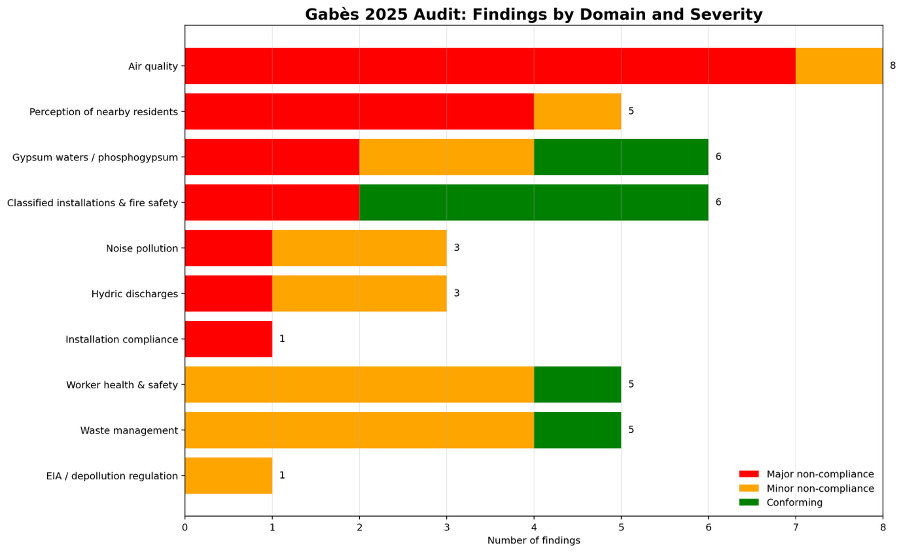
NB: The chart counts the number of findings in each category; it does not weight them by health risk, environmental impact, or financial cost.
The 2025 audit recorded the highest number of major non-compliance findings in the air-quality category. This finding comes against a longer history of environmental concerns in Gabès. Residents have raised air-quality concerns through protests, strikes, interviews, legal proceedings and other forms of public mobilisation. Since the 1990s, several environmental projects have also been financed with the stated objective of reducing pollution, including atmospheric emissions.
The audit’s assessment of air quality relied on the latest measurement campaign available to the auditors, conducted in 2010. The report therefore noted the absence of updated and continuous atmospheric monitoring. This gap is relevant to the assessment of any potential relationship between industrial emissions and reported respiratory health effects. Without recent and continuous measurements, the available data cannot establish changes in emissions over time or provide a current assessment of air quality around the industrial sites.
The issue also arises in relation to legal proceedings initiated following reports of respiratory incidents among residents in October 2025. The publicly available information does not establish what scientific evidence was available to prosecutors or what evidence was considered by the Court in assessing a possible link between industrial emissions and health effects. The absence of recent continuous monitoring also limits the availability of contemporaneous environmental measurements that could be used in such an assessment.
The audit identified non-compliance in relation to water discharges as well. Reported parameters included temperature, pH, fluorine and phosphorus, with measurements exceeding the applicable standards in the areas assessed. The report also identified weaknesses in operational monitoring procedures.
The audit further noted the absence of recent consolidated data on gypsum-water discharges and the lack of a formal management plan for phosphogypsum and gypsum waters. According to the audit, phosphogypsum is the main solid waste generated by the phosphate-processing activities in Gabès, with an estimated 14,000–15,000 tonnes of dry gypsum produced per day.
The availability of monitoring data is relevant when assessing changes in discharge levels over time. In particular, recent measurements would allow current discharge levels to be compared with the targets established under previous pollution-reduction projects. The audit’s findings therefore provide a documented assessment of the monitoring and compliance situation at the time of the 2025 assessment, while also identifying gaps in the availability of recent environmental data.
“Gabès’ phosphate-processing industry, dumped at an estimated 14,000–15,000 tonnes/day in the form dry gypsum, according to the audit.”
When documenting harm to residents, the audit gathered information through document review, site visits, consultations, questionnaires and interviews. It says the social survey involved 66 people, including around 58 residents and 6 association representatives, across areas such as Gabès city, Ghannouch, Chenini, Chott Essalam, Hamma, Menzel Habib, Oudhref, Hicha and Bouchemaa.
What was recorded was residents’ complaints linked to atmospheric emissions, including asphyxia, respiratory irritation and chronic discomfort.
Due to the methodology of the audit, there is no study into the scientific links between complaints of residents and industrial pollution. The audit confirms the suffering of residents, yet misses key information needed to facilitate legal action that protects them. Instead, the audit found repeated cases of missing, outdated, or discontinuous monitoring systems , exactly what would be instrumental to the kind of technical evidence required by courts.
GCT’s Improvement Plans After the 2025 Environmental Audit
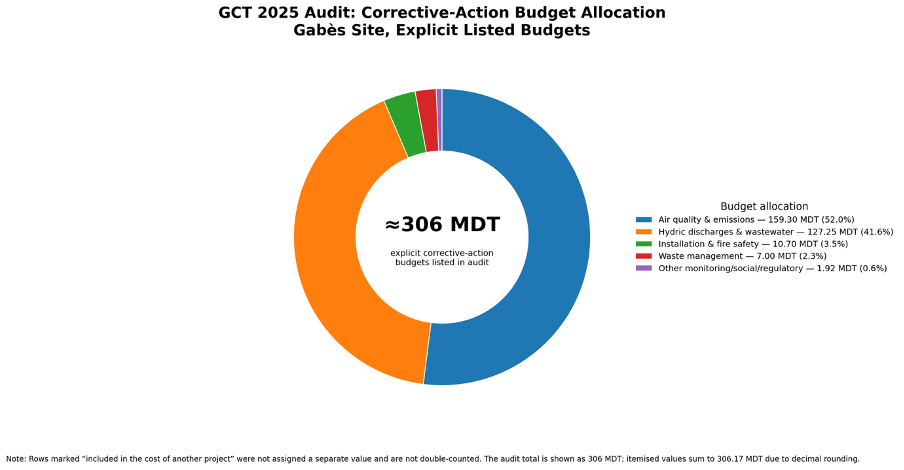
Following the findings identified in the audit, the GCT developed a Corrective Action Plan for the Gabès site. The plan includes technical, environmental, occupational safety, monitoring and community-management measures. It applies to the Gabès site and does not cover the GCT facilities in Skhira or M’dhilla.
The total estimated cost of the measures is 306 million Tunisian dinars (MDT), equivalent to more than US$104 million. The proposed measures and their estimated costs are shown in the chart below.
The largest allocations are for industrial upgrades. These include measures related to emission reduction, wastewater treatment and improvements intended to address the non-compliances identified in the audit.
PAER-GCT 2026: GCT’s New Plan to Reduce Pollution in Gabès
The audit was published in July 2025. In late January 2026, the African Development Bank (AfDB) Board approved US$110 million in financing for the PAER-GCT project, the Project for the Environmental Upgrading and Rehabilitation of the Production Units of the Tunisian Chemical Group. The project covers the GCT’s industrial sites in Gabès, Skhira and M’Dhilla and is scheduled for completion around 2031.
The PAER-GCT project follows the July 2025 audit and the Corrective Action Plan subsequently prepared for the Gabès site. The project documents identify measures related to the rehabilitation of production units, environmental performance, air-emission control and energy efficiency.
However, the publicly available information does not provide a complete mapping between the measures financed under PAER-GCT and all of the non-compliances identified in the audit.
The audit covered several areas beyond production-unit rehabilitation. These included water discharges, phosphogypsum and gypsum-water management, environmental monitoring, waste traceability, occupational safety and community-related procedures. Based on the public information currently available, it is not possible to establish the extent to which each of these areas is covered by PAER-GCT, or whether additional measures will be implemented outside the project.
The project’s implementation also remains to be assessed over time. Following the AfDB’s approval in January 2026, publicly available evidence of physical implementation would include completed infrastructure, operational monitoring equipment, procurement or construction milestones, and periodic progress reports. The available information does not establish the extent of implementation at this stage.
PAER-GCT is therefore part of a longer sequence of environmental improvement initiatives involving the GCT. Examining the implementation and outcomes of previous projects provides additional context for assessing how environmental commitments have progressed over time and for comparing those experiences with the current project.
Gabès’ Long History of Unfinished Environmental Projects
The publicly approved projects and the information available about their implementation are examined in this section. A recurring limitation across the available records is the lack of publicly accessible information on project expenditure, implementation progress and completed works.
The July 2025 GCT audit provides relevant context. Despite the environmental projects previously financed, the audit identified major non-compliances in several areas, including water discharges, air emissions and gypsum-water management.
Some of these areas had been addressed by the objectives of previous environmental improvement projects. However, the publicly available documentation does not provide sufficient information to determine the extent to which the measures were implemented, completed or achieved their intended environmental outcomes.
This creates several information gaps. The available records do not consistently show how allocated funds were spent, which works were completed, what measures became operational, or what environmental results were recorded following project implementation. The absence of such information also makes it difficult to compare the objectives of successive projects with their documented outcomes.
The following sections examine the GCT’s history of publicly approved environmental projects and the information available on their financing, implementation and reported outcomes. This provides a basis for comparing successive commitments with the evidence publicly available on their implementation and environmental results.
Gabès’ Early EIB and EU-Backed Pollution Projects
The European Investment Bank (EIB) is the lending institution of the European Union. It finances projects that support EU policy objectives, including environmental development and economic integration.
EIB financing for environmental projects in Gabès dates back to at least 1990. A €35 million project signed that year addressed industrial pollution, including the disposal of phosphogypsum on land rather than at sea. In 1991, a separate €7 million project was signed for the construction and extension of sewerage and wastewater-treatment facilities in Gabès and the surrounding area.
An EU document also lists two EIB-financed projects related to the environmental upgrading of GCT activities in Gabès. One concerned atmospheric pollution control in Gabès and dates to 1990. The other concerned the reduction of pollution in the Gulf of Gabès through the land disposal of phosphogypsum.
According to the document, these projects formed part of a broader approach in which EIB loans, combined with EU interest-rate subsidies, were used to finance environmental infrastructure.
The publicly available records reviewed for this investigation do not provide sufficient information to establish the subsequent implementation status, completion of works, expenditure or environmental outcomes of these two projects.
1999 EIB Loan: Ending Phosphogypsum Discharges into the Sea
In 1999, the European Investment Bank (EIB) announced €50.6 million in loans to the Tunisian Chemical Group (GCT) for the land disposal of phosphatic gypsum generated at the Gabès plant. According to the EIB, the project was intended to end the discharge of approximately 4.4 million tonnes of gypsum per year into the Gulf of Gabès.
The EIB described the financing as part of Tunisia’s National Environment Plan and the Euro-Mediterranean Partnership. The partnership linked environmental cooperation with broader objectives including regional stability, economic cooperation and trade integration.
The available public documentation reviewed for this investigation does not provide sufficient information to establish the project’s implementation status, the works completed, the expenditure incurred or its measured environmental outcomes.
The July 2025 GCT audit provides a later assessment of gypsum disposal in Gabès. It reported an estimated minimum of 5 million tonnes of gypsum discharged annually. This figure is higher than the 4.4 million tonnes per year cited by the EIB in 1999.
“It reported an estimated minimum of 5 million tonnes of gypsum discharged annually… higher than the 4.4 million tonnes per year cited by the EIB in 1999.”
However, the available documents do not establish whether the two figures were calculated using the same methodology, measurement period or scope. They therefore cannot, on their own, be used to determine the effectiveness or outcome of the 1999 project.
2008 and 2016 EIB Loans: Environmental Upgrades for GCT
In 2008, the EIB signed the GCT Environmental Upgrade project, with €55 million in proposed EIB financing and an estimated total cost of €120 million. The project focused on upgrading GCT facilities, particularly in Skhira and M’Dhilla, to meet Tunisian environmental standards and international best practices.
In 2016, the EIB signed a further €19 million loan for the project. Its objectives included reducing sulphur dioxide, ammonia and dust emissions; preventing hydrofluoric emissions from Skhira into the sea; developing controlled phosphogypsum disposal sites; and establishing environmental monitoring at production sites. Information on the project’s final outcomes is not provided in the available records.
MANE Programme: Environmental Upgrades in Sfax, Gabès and Gafsa
MANE refers to the environmental upgrading programme for the Groupe Chimique Tunisien (GCT), from the French mise à niveau environnementale. It comprises state-linked projects aimed at reducing pollution from existing GCT phosphate-processing units.
GCT is the main operator. The programme falls within Tunisia’s state industrial framework, under the ministry responsible for industry, energy and mines. It covers industrial sites in Sfax, Gabès and Gafsa, with an estimated total cost of 542 million dinars, or more than €150 million. In Gabès, the projects have a combined estimated cost of about 259 million dinars.
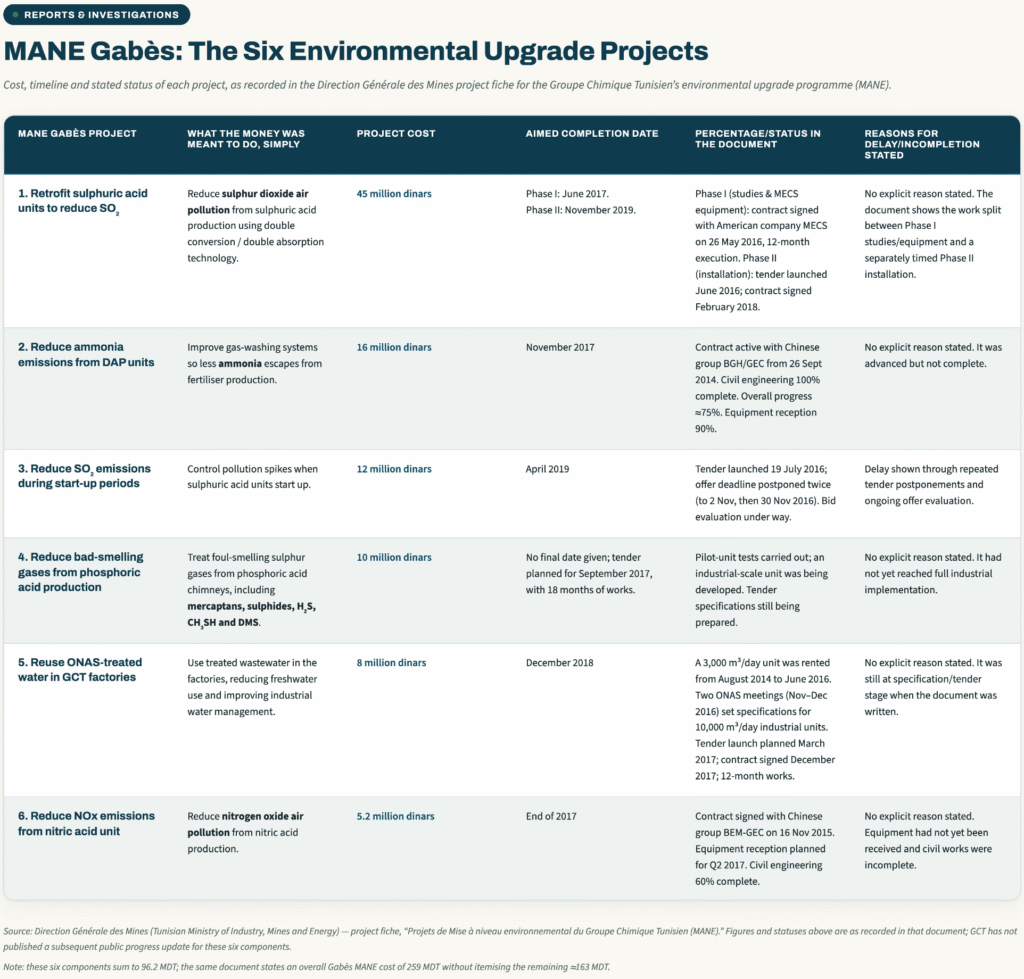
The document used for most of the details in the table reflects project statuses from late 2016 and early 2017. It records the progress of the projects at that time. It does not provide information on their subsequent completion, operation, maintenance or environmental performance.
Publicly available official updates on the projects’ later status are limited. During a plenary session of the Tunisian Parliament on 20 October 2025, MPs discussed the implementation of environmental projects linked to the phosphate industry and the continued status of pollution-control measures.
Gabès Pollution: The 2025 Parliamentary Debate
The parliamentary session on 20 October 2025 focused on the environmental situation in Gabès and pollution linked to the Tunisian Chemical Group (GCT). Health Minister Mustapha Ferjani said that six environmental projects in Gabès had reached advanced stages of completion before being halted. He also said that completing the projects could significantly reduce gas emissions.
Equipment and Housing Minister Salah Zouari said that the six projects, worth more than 200 million dinars, had not been completed. He announced that work would resume, with funding already allocated and the necessary studies completed.
The parliamentary session therefore provided official confirmation that several environmental projects launched in Gabès had remained unfinished. The Assembly’s own summary lists projects at different stages of completion, including a sulphur dioxide reduction project at 70%, an ammonia-gas washing project at 84%, and a nitrogen oxide reduction project at 98%.
The figures also show that reaching a high completion rate did not necessarily mean that a project had entered operation. Zouari said that the unfinished projects had contributed to the deterioration of the environmental situation in the region and called for their completion.
Three months later, on 28 January 2026, the African Development Bank approved US$110 million for the PAER-GCT project. The financing is intended to support the environmental upgrading and rehabilitation of GCT production units in Gabès, Skhira and M’Dhilla, including measures to reduce air pollution and improve environmental, energy and operational performance.
GCT and the Economic Model Behind Tunisia’s Phosphate Industry
Across its sites, the GCT processes phosphate into fertiliser products for domestic and international markets. The Gabès complex is Tunisia’s largest phosphate-processing facility and accounts for more than half of GCT’s output.
The GCT is a state-owned industrial group. Its operations are linked to phosphate processing, fertiliser production and international trade. The group operates within Tunisia’s state industrial framework and plays a role in the country’s phosphate and fertiliser sector.
CPG is responsible for phosphate mining, while GCT processes phosphate into fertiliser products. TIFERT, or Tunisian Indian Fertilisers (Société Tuniso-Indienne des Fertilisants), is a Tunisian-Indian joint venture involved in phosphoric acid production at Skhira.
TIFERT is owned by Tunisian and Indian partners. GCT and CPG are among its Tunisian shareholders, while Indian companies Coromandel International and Gujarat State Fertilizers and Chemicals hold a combined 30% stake. TIFERT exports phosphoric acid to India under long-term supply arrangements.
GCT and TIFERT are both involved in processing phosphate into products for international markets. These exports generate foreign-currency revenues. Foreign currency is used in Tunisia to finance imports and other external payments.
The phosphate industry is also connected to employment and transport infrastructure. In 2024, GCT directly employed more than 4,200 people, according to an African Development Bank document. The same document describes CPG as one of Tunisia’s largest employers.
The railway company SNCFT transports phosphate from CPG mining areas to processing facilities. The ports of Gabès, Skhira and Sfax also handle the movement and export of phosphate-derived products.These links connect mining, processing, rail transport, port infrastructure, employment and exports within the same industrial chain.
Lamia Mokaddem, Director of the Laboratory for the Economics of Sustainable Development, Natural Resources and Agriculture (LEDDRNA), described the potential economic effects of changes to GCT operations. She said that closing or relocating the polluting units in Gabès would have socio-economic consequences at both regional and national levels.
At the regional level, Mokaddem pointed to employment in Gabès and the role of industrial activity in household incomes. At the national level, she cited GCT exports, foreign-currency revenues and Tunisia’s participation in international fertiliser markets.
The economic importance of the phosphate sector is also reflected in its role in Tunisia’s export activity and industrial production. The scale of any economic effects from changes in phosphate production would depend on factors including production levels, export revenues, employment and the availability of alternative sources of fertilisers and foreign currency.
Information on the sector’s financial flows is not fully available publicly. The Natural Resource Governance Institute’s 2021 Resource Governance Index assessed Tunisia’s phosphate-mining governance and identified gaps in financial reporting and commodity-sales disclosures by the state-owned CPG.
The assessment also noted that CPG did not publish information on the buyers or timing of individual phosphate sales and did not provide public information on its joint ventures and subsidiaries.
The available financial and production data therefore provide only part of the picture. The next section examines government plans to increase phosphate production alongside the environmental measures planned for the sector.
Why Is the Government Betting on More Phosphate Production?
In March 2025, the Tunisian government approved a 2025–2030 programme covering phosphate production, transport and processing. The programme targets annual phosphate production of 14 million tonnes by 2030, compared with less than 3 million tonnes in 2025.
The programme follows a 2017 government commitment concerning pollution from phosphate processing. After protests and public mobilisation, a Council of Ministers meeting was held on 29 June 2017. Nawaat reported that the meeting resulted in a decision to dismantle pollution-producing units operated by the Chemical Group. Other reports described the commitment as a gradual dismantling or relocation of the most polluting facilities.
The two government programmes set different objectives for the sector. The 2017 measures focused on reducing pollution from existing facilities. The 2025 programme combines increased phosphate production with industrial rehabilitation and environmental measures.
Tunisia recorded 63.7 billion dinars in exports and 85.5 billion dinars in imports in 2025, resulting in a trade deficit of 21.8 billion dinars, according to the National Institute of Statistics. A 2025 World Bank report also noted Tunisia’s increased reliance on domestic sources to meet financing needs, including foreign-exchange borrowing from the Central Bank.
Phosphate and fertiliser production contributes to Tunisia’s export activity. GCT processes phosphate into higher-value products, including phosphoric acid and fertilisers, which are exported to international markets. Export revenues generate foreign currency for the country.
The sector has also operated at significantly higher production levels in the past. Tunisia produced about 8.2 million tonnes of phosphate in 2010. Production fell to less than 3 million tonnes in 2025, according to Reuters. The decline followed protests, strikes and other disruptions after the 2011 revolution.
The 2025–2030 programme therefore sets a production target substantially above recent output levels. It also includes measures to rehabilitate production facilities and increase processing capacity.
Environmental requirements form another part of the sector’s international trade context. The European Union is Tunisia’s largest foreign-investment partner, according to the European Commission. Tunisia and the EU have traded under an Association Agreement since 1998. The agreement includes provisions concerning environmental cooperation and sustainable development.
The EU’s Carbon Border Adjustment Mechanism entered its definitive regime in 2026. CBAM covers several sectors, including fertilisers, and applies a carbon price to the embedded emissions of covered goods imported into the EU. The mechanism creates additional requirements concerning emissions data and carbon costs for covered exports to the European market.
Environmental upgrading projects are therefore part of both domestic environmental policy and the wider regulatory context for phosphate and fertiliser production. Previous projects have included emission-control systems, waste-management infrastructure and environmental monitoring.
The implementation record of these projects remains uneven. Earlier project documents recorded different levels of completion, while parliamentary discussions in 2025 documented several projects that had reached advanced stages without entering operation.
Publicly available information does not establish why individual projects remained unfinished. It also does not establish whether environmental projects were designed primarily to address local pollution, meet regulatory requirements, support international trade, or serve several of these purposes simultaneously.
The economic effects of increased phosphate production also extend beyond export revenues. The sector is connected to employment, rail transport, ports, energy use and other industrial activities. Environmental impacts can generate additional costs in areas such as public health, agriculture, fisheries, water resources and land management.
The available public data do not provide a single consolidated assessment of these economic and environmental costs. This makes it difficult to compare the projected economic benefits of higher phosphate production with the costs associated with environmental impacts and pollution-control measures.
So What’s Next?
In March 2025, the Tunisian government approved a 2025–2030 programme covering phosphate production, transport and processing. It targets annual phosphate production of 14 million tonnes by 2030. It also aims to raise GCT plant activity to 80% of design capacity by 2028. The programme covers production, transport, water resources, industrial maintenance and environmental management.
The target follows years of lower production. Tunisia produced about 8.2 million tonnes of phosphate in 2010. Production fell to less than 3 million tonnes in 2025, according to Reuters. The decline followed protests, strikes and other disruptions across the sector after the 2011 revolution.
The programme includes several industrial projects. These include the rehabilitation of sulphuric-acid units, new production facilities at Skhira, a purified phosphoric-acid unit, cadmium treatment at M’Dhilla, and measures to treat emissions from phosphoric-acid production at Gabès, Skhira and M’Dhilla.
The programme follows a 2017 government commitment on pollution from phosphate processing. After a restricted Council of Ministers meeting on 29 June 2017, the government announced measures to stop phosphogypsum discharge into the Gulf of Gabès and dismantle polluting production units. The plan also included replacing them with facilities designed to meet Tunisian and international environmental standards.
Tunisia’s trade position has also changed since 2017. In 2025, the country recorded 63.7 billion dinars in exports and 85.5 billion dinars in imports, resulting in a trade deficit of 21.8 billion dinars, according to the National Institute of Statistics.
The government has linked phosphate production to exports and the balance of payments. When approving the 2025–2030 programme, it identified the sector as a contributor to exports, the balance of payments and national economic activity.
Environmental requirements also form part of the sector’s international trade context. Tunisia and the European Union have traded under an Association Agreement since 1998. The EU’s Carbon Border Adjustment Mechanism entered its definitive regime in 2026. CBAM covers several sectors, including fertilisers, and applies a carbon price to the embedded emissions of covered goods imported into the EU.
The phosphate and fertiliser sector is therefore subject to both production and environmental requirements in international markets. The 2025–2030 government programme includes environmental measures alongside its production targets. These include emission-treatment measures and the proposed recovery of fluorine emissions.
The implementation of earlier environmental projects remains relevant to the new programme. Previous documents recorded project investments and completion rates. Parliamentary discussions in 2025 also documented projects that had reached advanced stages without entering operation.
The 2025–2030 programme combines increased production targets with new industrial and environmental measures. Public information does not establish why earlier environmental projects remained unfinished. Their subsequent completion, operation and maintenance will determine the implementation of the environmental measures included in the new programme.
Copyright © 2026 Blue Tunisia. Tous droits réservés